Local Words: When a Place Name Has More Than One Story
Local words can preserve sound, spelling, and memory without settling a place name’s origin. Compare clues, record their sources, and write a careful account.
The common mistake with local words is copying the first familiar explanation of a place name as though it were the only one. That can cost a community the chance to preserve how residents actually say the name, including variations that a map or sign leaves out.
To document a place name well, keep three things distinct: spoken forms, written forms, and the words people use to explain it. Each can help readers understand local language, but they are not interchangeable.
How do you record local pronunciation?
Ask residents to say the name naturally in a sentence rather than reading it from a sign. Listen for the syllables they stress, the sounds they use, and any differences between speakers. Record what you hear in ordinary spelling first; use a technical pronunciation system only if you can apply it accurately.
For example, one resident might pronounce a village name with a clear final syllable while another blends it into the next word. Write down both versions and identify them as pronunciations you heard, rather than correcting either one to match the map.
Current pronunciation tells you how those speakers use the name. It can be useful in a local-language record, but it does not by itself tell you how the name was formed or how people said it in the past.
How should you compare written versions?
Check the spelling on a road sign, current map, local directory, and older records you can access. Copy each version exactly, including spaces and unusual letter combinations. Note where it appeared and any date or context you can verify.
A changed letter may reflect someone’s effort to record an unfamiliar sound, or a later choice to standardize a written form. Treat each spelling as evidence of how a particular source wrote the name—not as a pronunciation guide or an automatic explanation of its meaning.
A simple record can use three columns:
- What to check: The spelling on a current road sign. If: It matches the current map, use that form in the main text; then: note any other spellings separately.
- What to check: An older map or directory. If: The name differs, copy its form and source exactly; then: describe it as a variant, not proof of a different origin.
- What to check: Whether an older record is an original or a later copy. If: You cannot establish that, say the record’s status is unclear; then: avoid making a firm claim based on it.
- What to check: How residents pronounce the name. If: You hear more than one form, record each with the speaker’s permission; then: do not silently select one as the only local form.
- What to check: A remembered explanation. If: The speaker identifies who shared it or where they heard it, include that context; then: attribute the account rather than presenting it as settled history.
- What to check: Whether you have permission to identify a speaker. If: You do not, leave out identifying details; then: describe the source more generally, such as a resident’s account.
How do you include a remembered explanation?
A family account or local explanation can show what a name means to people who use it. Ask who shared the account, what words they used, and whether they remember hearing it from someone else. Keep the speaker’s wording where possible, and get permission before identifying them in a public display or article.
Use precise phrases such as “one family account connects the name with…” or “some residents explain it as….” Avoid writing “the name comes from…” unless the sources support that stronger statement. This distinction lets the account remain part of the local record without claiming more than the evidence can support.
How can you put the clues together?
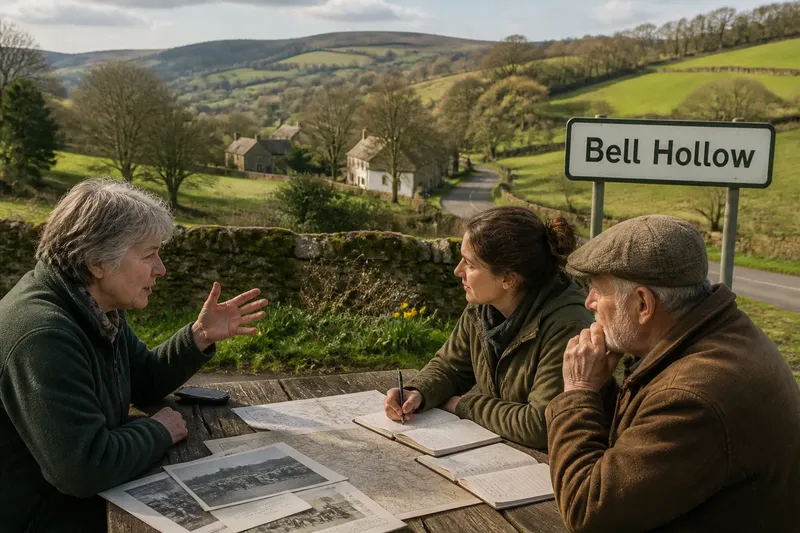
Say you are preparing a display about a fictional rural place called Bell Hollow. A neighbor recalls that its name came from a bell heard across the valley. The current road sign reads “Bell Hollow,” an older map spells it “Belle Hallow,” and residents pronounce the second word in different ways.
Start by recording the inputs: the neighbor’s account and its source, the sign’s exact spelling, the older map’s spelling and whether it is an original or copy, and the pronunciations you heard. Next, group them by type: remembered explanation, current public spelling, older written variant, and present-day speech. If the map’s source remains unclear, mark that uncertainty instead of treating its spelling as an answer.
The resulting display could say that a bell story is remembered locally, that an older map uses a different spelling, and that residents pronounce the name in more than one way. It should leave the origin open unless further sources clarify it. The tradeoff is straightforward: the display makes a narrower claim, but preserves more of what people actually said and recorded.
Think of the sources like objects in separate drawers: a sign, a map, and a spoken account may all belong in the same archive, but one should not be mistaken for another.
What do readers ask about local words?
Does local pronunciation prove a place name’s origin?
No. It records how a speaker says the name and may preserve a form used in local speech. Pair it with written sources and attributed accounts, while keeping its limits clear.
Which spelling should I use in a local history?
Use the current official or commonly used spelling in the main text, then note meaningful variants and where they appeared. If your purpose is to document speech, record the spoken form separately.
Can I include a family explanation if its origin is uncertain?
Yes, if it matters to local memory and you present it as an account rather than an established origin. Attribute it appropriately, seek permission where needed, and do not add details the speaker did not share.
How should I show that a spelling’s source is unclear?
State what you can verify, such as where you found the spelling, and say what you could not establish, such as whether the record is an original. That gives readers useful context without asking them to treat an uncertain source as conclusive.
How do you write a clear local words entry?
Put the current name in the main text, then distinguish the pronunciation, written variants, and remembered explanations in separate sentences. Name the source for each detail where you can, and use wording such as “recorded on,” “pronounced by,” or “recalled by” to make the evidence easy to follow.
A careful local words entry does not need to settle every place name’s origin. By recording who used a form and where it appeared, you give the next reader enough context to add information without mistaking a familiar account for the only story.