Why Folklore Symbols Change Meaning Across Generations
Understand how folklore symbols change meaning across generations, and learn to record the people, occasions, and memories that keep local stories alive.
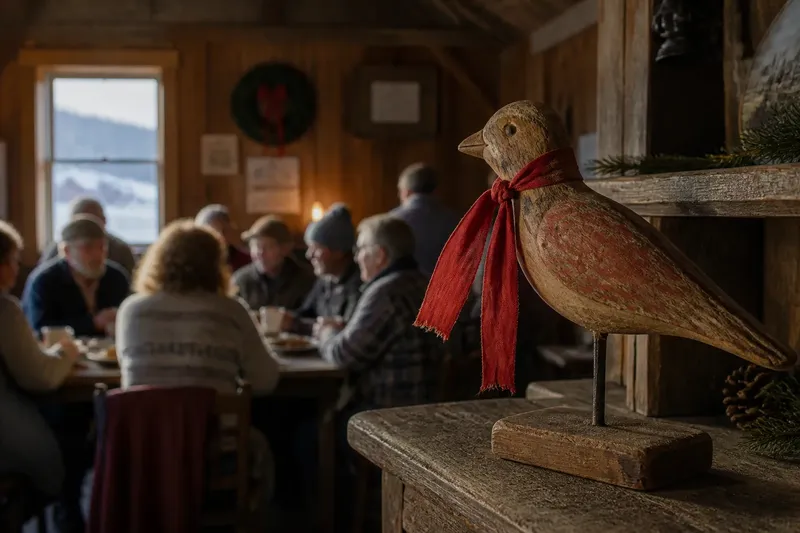
The most common mistake with folklore symbols is to treat a familiar object as a fixed emblem and skip the stories people attach to it. That shortcut can make a local custom easier to explain, but it can also erase how a meaning shifted as families and neighbors passed the object along.
A carved bird, a ribbon, or a mark on a gate may be part of a seasonal ritual, a household memory, or simply an object someone made. To describe it well, follow its path through people’s lives rather than searching for a single definition.
How do folklore symbols change meaning across generations?
A symbol can acquire new associations each time someone uses it in a different setting. A ribbon worn at a community dance might later be tucked into a family Bible, then displayed at a local gathering. Its appearance stays much the same, but the people handling it connect it to different moments.
Memory also changes what gets emphasized. One generation may remember who made an object; another may recall the occasion when it was first brought out. Like a well-used recipe card, the object can carry a history that is richer than the few words written beside it.
These accounts need not compete. One may describe the object’s making, another its use, and a third the meaning it holds for someone now. Keep those distinctions visible instead of forcing them into a single origin story.
What details help explain a symbol’s local use?
Begin with the circumstances in which people encounter the object. Note who handles it, where it appears, and whether it is tied to a particular gathering, task, or household. A painted shape on a barn door, for instance, may be understood differently from the same shape stitched onto clothing.
Pay attention to names and expressions, too. A local nickname may refer to a person, a joke, or an event that is not obvious to visitors. A literal translation can preserve the words while missing the shared memory behind them.
Ask people to describe what they do with the symbol, not only what they think it means. An account of when it is brought out or who is expected to handle it can reveal how the custom works in daily life.
How can you record a symbol’s story without flattening it?
Separate visible details from people’s explanations. Describe the object’s material, color, shape, and location first; then identify whose account supplies each interpretation. This makes it easier for a reader to tell observation from memory or personal belief.
- Check the object’s setting. If it appears in a specific household or gathering, describe that setting; if its original setting is unknown, say so rather than assigning a customary use.
- Check who handles it. If a maker or regular user can be identified, attribute the account to that person; if not, describe the source of the information or leave the user unidentified.
- Check the occasion. If people connect the symbol with a seasonal event, name that event; if accounts point to different occasions, record each separately.
- Check the exact local name. If speakers use a nickname or phrase, preserve it and ask what it refers to; if its meaning is unclear, keep the wording and mark the explanation as unknown.
- Check how the account was learned. If someone remembers the event directly, describe it as personal recollection; if the story came through another teller, identify it as a family or community retelling.
- Check whether accounts differ. If people offer distinct readings, attribute each one; if no one describes a second reading, avoid claiming that the symbol has several meanings.
Say, “Mara remembers the ribbon from her family’s spring gathering,” rather than “The ribbon means renewal.” The first sentence tells readers who holds the memory and where it belongs; the second turns one interpretation into a rule.
What questions help uncover a symbol’s story?
Who made or first used this symbol?
Ask who handled the object and in what setting. If the person is unknown, that answer helps define what you should avoid claiming about its origin.
When does it come out, and who is there?
Ask about the occasion and the people involved. The answer can show whether the symbol belongs to a household practice, a public celebration, or another setting.
What do you remember about it?
This invites a personal account rather than a verdict on what everyone should think. Follow up by asking whether the memory comes from direct experience or from someone else’s telling.
Do other people in the community tell it differently?
Ask whether the speaker knows of another version, then record the answer in that person’s terms. If no other account is available, do not imply that disagreement exists.
How should you handle conflicting memories?
Keep each account attached to its teller, setting, and time frame. A disagreement may reflect different family experiences or a custom that changed; it does not, by itself, tell you which person is right.
Say you are preparing a library display about a wooden bird kept in a village hall. In this invented situation, the starting information is a bird with a faded red ribbon, one caretaker’s recollection that it was carried at a winter supper, and a former organizer’s memory that it stayed on the hall shelf all year. You write down both accounts, ask each person how they learned the detail, and check the hall’s surviving event notes; the notes mention the supper but do not say whether the bird was carried. The resulting caption states that the caretaker remembers it being carried at the supper, while the organizer recalls it as a year-round decoration, and leaves its original use unresolved. That wording gives visitors useful context without pretending the notes settle the difference.
For a short label, choose one account only if you identify whose account it is. If space allows, add a second sentence naming another recollection. When the evidence does not resolve the question, say so plainly rather than turning a guess into a local fact.
When is a short explanation too simple?
A concise explanation works when it names its limits: one family’s account, one person’s memory, or one use at a particular gathering. It becomes misleading when it presents that account as a universal definition or ignores other well-described uses.
When writing about a living custom, favor precise attribution over confident generalization. The phrase “some families in the valley remember the ribbon from a spring gathering” makes a narrower claim than “the ribbon symbolizes spring,” and readers can see whose understanding is being described.
Use folklore symbols as an invitation to ask who remembers them, how they were used, and what changed along the way. That approach to folklore symbol meaning gives readers a more useful account than a neat label, especially when a story’s oldest version remains unknown.